OUR CLERGY
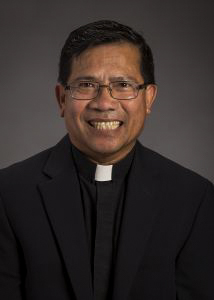
Father Joseph Dinh
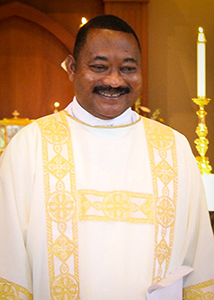
Emmanuel Ukattah, Deacon
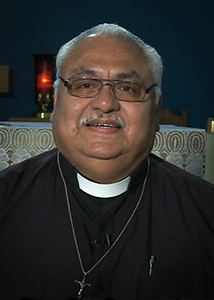
Enedino Aquino, Deacon
Father Joseph Dinh
Emmanuel Ukattah, Deacon
Enedino Aquino, Deacon
Brothers and Sisters in Christ,
The Kingdom of God is like a royal wedding banquet. It is indeed a joyful event. The King in the parable has a long list of people invited to a wedding banquet. Sadly the invited guests refuse to come. They have more important things on their mind. They even make fun of the King’s messengers and mistreat them. The message of this parable is clear: Jesus invites the people of Israel to his wedding banquet in the Kingdom of Heaven but many refuse to come. He repeatedly invites them but they completely fail to take up his invitation. The Chosen People have ignored his invitation so God invites all the other people of the world instead.
We recognize that this parable is good news for us. We are “Gentiles” and we have taken up God’s invitation and we are here at the great banquet he has prepared for us. But there is also a warning contained in the story which we should be aware of. We remember the man who is found not wearing a wedding garment and then being thrown out of the banquet. What is it about?
The wedding garment is also a symbol. It represents our new life in Christ. When we accepted God’s invitation we left the old life of sin and began to live a new life of love and goodness. It is as if we left off our old clothes and put on new ones. When we answer God’s call and come to the waters of Baptism, God forgives all our sins and opens up a new way of life for us. We begin to live a new life in Christ. However, these new clothes of goodness, truth and love are put aside when we sin. It is as if we have taken off the new clothes and put back on the old clothes of sinfulness.
The man without a wedding garment in the parable represents us when we sin. We all sin. But as soon as we realize our sinfulness, we need to come to our senses and re-clothe ourselves in Christ. We must, for our own sake, return to God immediately to seek forgiveness. This is one of the greatest joys of being a Christian that we know we can always return to our forgiving and loving Lord.
May God bless us all!
Fr. Joe

Christ the King Church was founded in 1940 to serve the African-American Catholics in High Point, and has since become a multi-ethnic parish celebrating both the diversity and unity of the Catholic faith and tradition. Then-Bishop Eugene F. McGuinness of Raleigh invited the Franciscan Friars of the Atonement of Graymoor, NY to staff the new mission in High Point in 1940. Father Bernardine Watson served as the first pastor, originally celebrating Mass in a funeral home. Through the generosity and perseverance of Father Watson and several benefactors, a clothing shop was acquired for use by the mission. While Mass continued to be celebrated there during much of 1941, the mission community members also turned their attention to building a new church and rectory on Kivett Drive. The new colonial-style church was dedicated by Bishop McGuinness Dec. 14, 1941.
During the 1940s and into the ’50s, the Christ the King parish community continued to grow. A school building and convent were built in 1949, and in 1950 the Franciscan Handmaids arrived from New York City to staff the school. The African-American communities, both Catholic and non-Catholic, of High Point, Thomasville and Greensboro were served by the new Christ the King School, which opened its doors to 50 students in September 1950. The friars continued their pastorate in High Point for the next several decades, cultivating a faith community that became continually more culturally diverse over time. A stained-glass window behind the church’s choir loft depicts that diversity, with Jesus surrounded by four individuals representing the African, Asian, European and Indian bloodlines that make up much of the parish community today.
Lowering enrollment, financial difficulties and the recalling of the sisters to New York forced Christ the King School to close in 1981. The diocesan office of education converted the school for use as a day care center, which began its operation in August 1981. That same year, Franciscan Sisters of the Atonement arrived at Christ the King Church to conduct the religious education program and other ministerial work, including assisting at the day care center. The center, still located on parish grounds, is now privately operated and continues to serve the area.
Upon the friars’ leaving High Point in 1991, Christ the King Church became a diocesan parish in December of that year. Fathers Martin Madison and John Hoover served the parish until December 1994, when Father Philip Kollithanath, was appointed to Christ the King Church. Assisting in the advancing growth of the Christ the King community have been many commissions and ministries focusing on the spiritual , educational, multicultural and evangelical dimensions of the parish. Parishioners gather to engage in Bible study , to learn English as a Second Language, to put their faith into action in the local community and to celebrate their ethnicity. A Hispanic center and bilingual religious education program provide sharing and learning opportunities for English and Spanish speaking parishioners, and the parish African-American Ministry offers outreach programs benefiting the local region. The Women’s Guild, Altar Guild, 55+ Club and Young & Spirited Group are active in parish and community services, and the evangelization commission provides for the spiritual needs of homebound parishioners through its Visitation Ministry. The community of Christ the King Church looks ahead to expansion and renovation projects that will accommodate the needs of a growing parish. One hundred and sixty-one households currently make up the parish registry.